Tap the image to enlarge

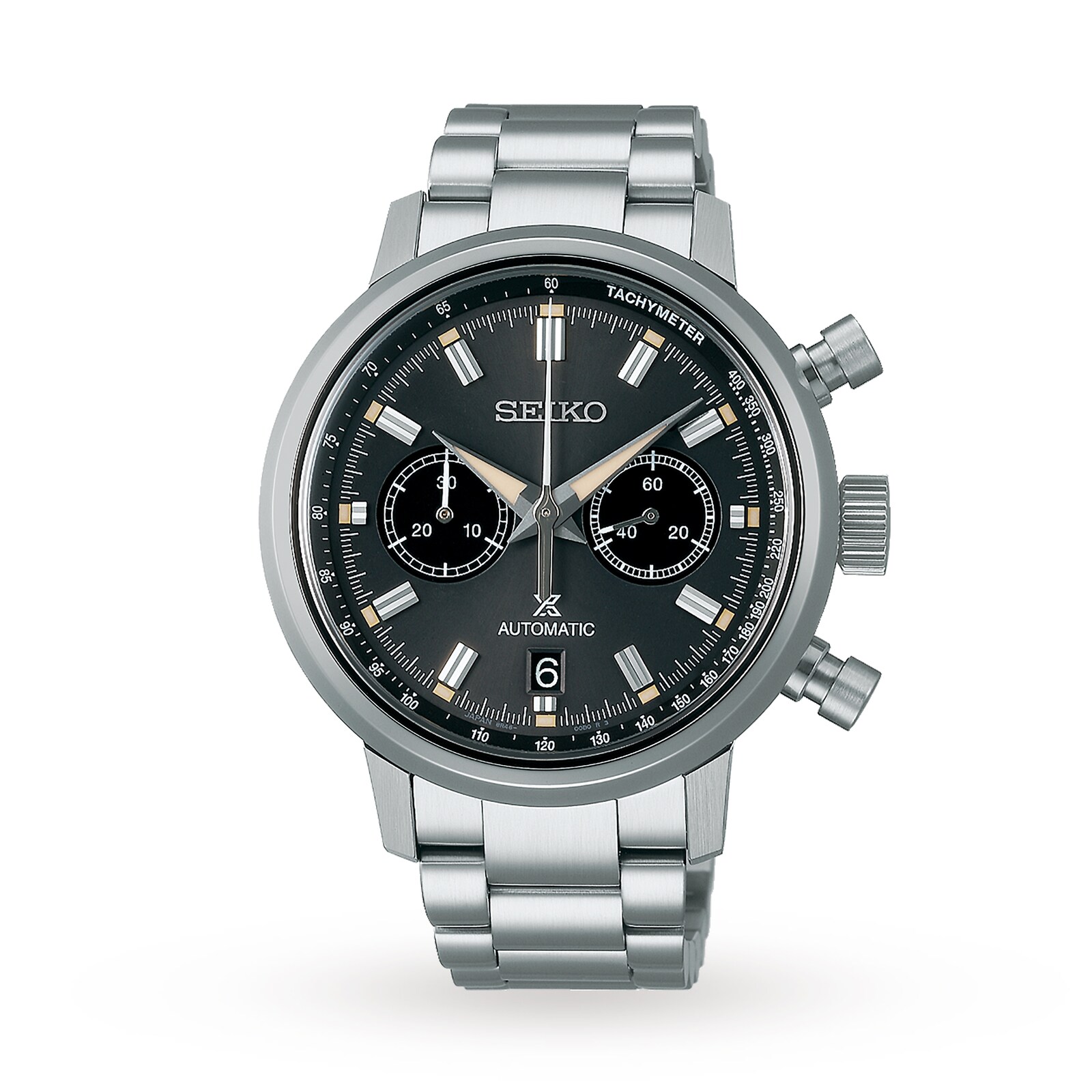
Seiko Speedtimer 1964 Chronograph Re-Creation 42.5mm
Ref. SRQ037J1
The Crown Chronograph of 1964 was not a fashion exercise. Seiko built it to serve as official timer for Tokyo's international athletics, with no prior experience of professional chronograph manufacture, and the discipline that came from that pressure — legibility above all else, mechanical reliability as an absolute — became the template the company has drawn on ever since. The SRQ037J1 recreates the aesthetic directly: the charcoal dial, the bevelled hour markers, the pump-style pushers are all lifted from that original instrument. The 8R46 movement is the detail that separates this from a cosmetic tribute. Column wheel and vertical clutch architecture places it alongside Swiss mechanisms that cost considerably more to produce, and the result is a chronograph start that engages without the brief hand-judder common in lesser lateral-clutch designs. At 42.5mm and 15.1mm thick this is an unambiguously substantial piece, but the multi-row bracelet is engineered to pull the centre of gravity down toward the wrist rather than letting the case sit proud of it — at 194 grams in steel, that calibration matters. The super-hard coating applied to both case and bracelet is worth noting because it treats them as a single surface rather than leaving the links visibly softer than the case over time — a small decision that keeps the whole thing looking coherent after two years of daily wear.
- Reference
- SRQ037J1
- Brand
- Seiko
- Collection
- Speedtimer
- Case size
- 42.5mm
- Case thickness
- 15.1mm
- Lug width
- 20mm
- Case material
- Stainless steel
- Case shape
- Round
- Dial
- Grey
- Crystal
- Sapphire
- Movement
- Automatic
- Calibre
- 8R46
- Functions
- Chronograph, Date, Small seconds, Tachymeter
- Water resistance
- 100m
- Bracelet / strap
- Stainless steel bracelet
- Strap colour
- Silver
- Clasp
- Three-fold clasp
- Lume
- LumiBrite
- Condition
- Pre-owned
- Retailer
- Mappin & Webb
Additional specifications
- Power reserve
- 45 hours
Learn more about Seiko
Kintaro Hattori opened a watch and clock shop in Tokyo in 1881, aged twenty-one, and began manufacturing under the name Seikosha — roughly, house of exquisite workmanship — in 1892. The Seiko name appeared on watches from 1924.
The company's significance is that it broke the Swiss monopoly twice. First on precision: Seiko was appointed official timekeeper of the 1964 Tokyo Olympics and built the quartz chronometers and printing timers to do it, and in the 1960s its movements placed highly at the Neuchâtel and Geneva observatory trials against the best Swiss houses.
Then on technology. On Christmas Day 1969 Seiko released the Astron, the world's first quartz wristwatch, accurate to five seconds a month where mechanical watches managed that per day. The consequences for Switzerland were catastrophic — employment in the Swiss industry fell by roughly two-thirds over the following decade. Seiko deliberately did not enforce its quartz patents, allowing the technology to spread.
The same year it produced the 6139, among the first automatic chronographs, and it has since introduced Kinetic, Spring Drive — a hybrid regulating a mechanical mainspring electronically, giving a perfectly gliding seconds hand — and its own dive and field lines.
Seiko remains fully vertically integrated, making its own hairsprings, quartz crystals, and even the Zaratsu-polished cases, at price points from under a hundred pounds upward.
- 1881
- Kintaro Hattori opens his Tokyo shop.
- 1924
- The first watches carry the Seiko name.
- 1964
- Official timekeeper of the Tokyo Olympics.
- 1969
- The Astron becomes the first quartz wristwatch.
- 1999
- Spring Drive enters production.
Also in 7 collections
This watch appears in the Seiko Speedtimer range (16), Back in Stock (4,847), Stainless Steel Watches (3,197), Automatic Watches (1,736), Chronograph Watches (1,234), Pre-Owned, Ex-Display & Vintage Watches (344) and Grey Dial Watches (243).
Best of 2 retailers
What the specifications mean
A mechanical watch for everyday wear.
Strengths
- 100m water resistance covers swimming and watersports
- Sapphire crystal, which resists scratching
- Luminous hands and markers for low light
Worth knowing
- 15.1mm thick, so it will not disappear under a cuff
Seiko Speedtimer 1964 alternatives
Watches from other brands at a similar price, style and size, so you can see what else your budget can buy.
| Specification | SRQ037J1 | WAR2A11.FC6337 | A25310241K1X1 |
|---|---|---|---|
| Price | £2,350 | £2,450 | £2,760 |
| Case size | 42.5mm | 43mm | 42mm |
| Water resistance | 100m | 100m | 100m |
| Movement | Automatic | Automatic | Automatic |
| Strap | Stainless steel bracelet | Leather strap | Leather strap |
| Power reserve | 45 hours | 38 hours | 42 hours |
| This watch | Closely matched |
|

Your new watch
Frequently asked questions, and things you should know about this watch
Can I swim with it?
Yes. At 100m it is rated for swimming and snorkelling, though not for diving.
Water resistance explainedWill the glass scratch?
Unlikely. Sapphire is second only to diamond in hardness and shrugs off everyday marking.
Sapphire, mineral and acrylic comparedDoes it need a battery?
No. It is automatic — the motion of your wrist winds it, and there is no cell to replace.
Quartz, automatic and solar comparedHow long does it run for when it's not worn?
About 45 hours fully wound — enough to survive a night off the wrist, but not a full weekend.
What size strap does it take?
20mm. Any strap of that width will fit, and on most modern watches quick-release bars make the swap a two-minute job with no tools.
Is it a men's or women's watch?
Listed as men's.
Cheapest place to buy
Both Mappin & Webb and Goldsmiths list it at £2,350, so choose on delivery and warranty rather than price.
More Seiko watches like the Speedtimer 1964
In stock, and close on style and price