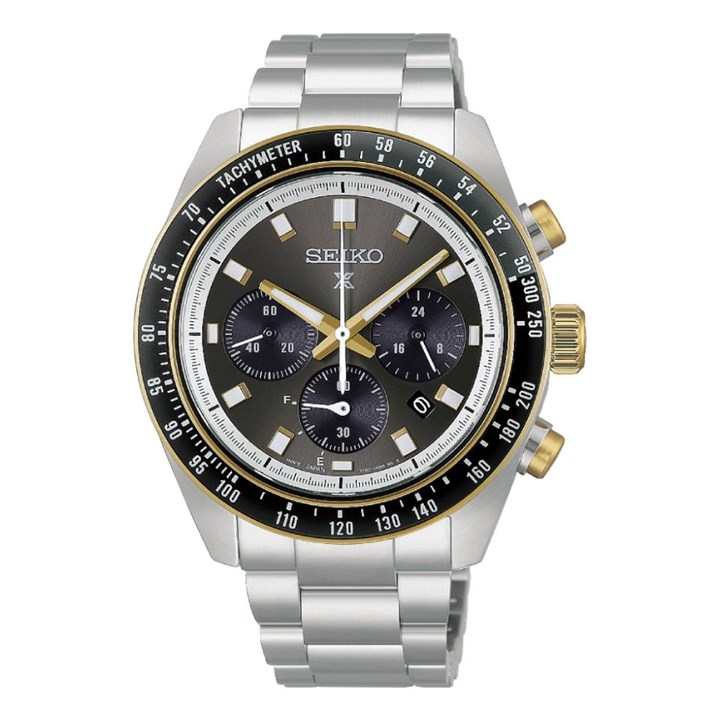
Tap the image to enlarge

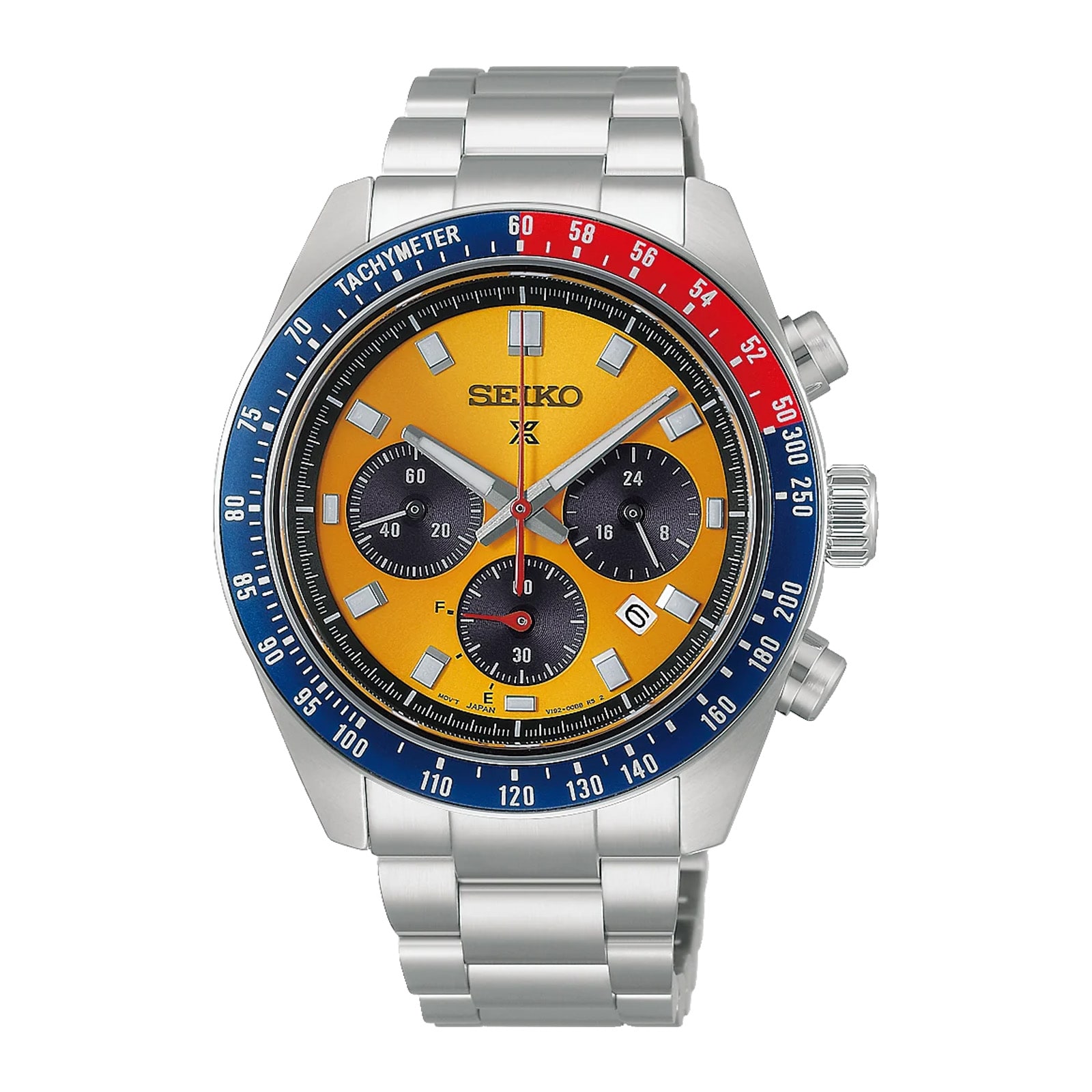
Seiko HBJ002P1 Solar Speedtimer 'Racing' Watch - W25596
Ref. HBJ002P1
Sits in Seiko’s upper tier here — more premium than three quarters of the Seiko watches we list, which start at £110.
Price range £110 to £3,550 across 187 Seiko watches in stock.The Speedtimer name traces to 1969, when Seiko produced one of the first automatic chronographs to reach the market. This "Classic Motorsports" release, launched in late 2026, draws on that lineage without pretending to be a reissue — the grey sunray dial with blacked-out sub-dials and gold trim on the tachymeter bezel evokes the colour palette of period racing cars without lifting any single detail directly from them. At 45.9mm lug to lug, the case wears considerably shorter on the wrist than its 41.4mm width might suggest, which is unusual for a full-function chronograph and means it disappears under a shirt cuff rather than fighting it. The V192 solar calibre brings a practical advantage beyond the obvious one: the power reserve indicator that serves as a secondary hand when timing is not active means you always know where the watch stands without pulling it from the wrist. The bracelet is integrated with solid end links and resizes via a standard pin-and-collar system rather than the proprietary tools some manufacturers require. Six months of reserve on a full charge means neglect of the kind that kills a battery-powered chronograph will not trouble this one.
- Reference
- HBJ002P1
- Brand
- Seiko
- Collection
- Speedtimer
- Case size
- 41.4mm
- Case thickness
- 13mm
- Lug width
- 21mm
- Case material
- Stainless steel
- Case shape
- Round
- Dial
- Grey
- Crystal
- Sapphire
- Bezel
- Fixed tachymeter
- Movement
- Quartz
- Calibre
- V192
- Functions
- Chronograph, Date, Small seconds, Power reserve indicator, Tachymeter
- Water resistance
- 100m
- Bracelet / strap
- Stainless steel bracelet
- Strap colour
- Silver
- Clasp
- Three-fold clasp
- Lume
- LumiBrite
- Retailer
- F.Hinds
Additional specifications
- Lug-to-lug
- 45.9mm
- Weight
- 168g
Learn more about Seiko
Kintaro Hattori opened a watch and clock shop in Tokyo in 1881, aged twenty-one, and began manufacturing under the name Seikosha — roughly, house of exquisite workmanship — in 1892. The Seiko name appeared on watches from 1924.
The company's significance is that it broke the Swiss monopoly twice. First on precision: Seiko was appointed official timekeeper of the 1964 Tokyo Olympics and built the quartz chronometers and printing timers to do it, and in the 1960s its movements placed highly at the Neuchâtel and Geneva observatory trials against the best Swiss houses.
Then on technology. On Christmas Day 1969 Seiko released the Astron, the world's first quartz wristwatch, accurate to five seconds a month where mechanical watches managed that per day. The consequences for Switzerland were catastrophic — employment in the Swiss industry fell by roughly two-thirds over the following decade. Seiko deliberately did not enforce its quartz patents, allowing the technology to spread.
The same year it produced the 6139, among the first automatic chronographs, and it has since introduced Kinetic, Spring Drive — a hybrid regulating a mechanical mainspring electronically, giving a perfectly gliding seconds hand — and its own dive and field lines.
Seiko remains fully vertically integrated, making its own hairsprings, quartz crystals, and even the Zaratsu-polished cases, at price points from under a hundred pounds upward.
- 1881
- Kintaro Hattori opens his Tokyo shop.
- 1924
- The first watches carry the Seiko name.
- 1964
- Official timekeeper of the Tokyo Olympics.
- 1969
- The Astron becomes the first quartz wristwatch.
- 1999
- Spring Drive enters production.
Also in 6 collections
This watch appears in the Seiko Speedtimer range (18), Back in Stock (4,868), Stainless Steel Watches (3,133), Chronograph Watches (1,199), Sports Watches (800) and Grey Dial Watches (256).
Temporarily out of stock
F.Hinds is not currently taking orders for this reference. Last listed as available on 13 November 2026. Stock is checked nightly and this page updates when it returns.
What the specifications mean
Strengths
- 100m water resistance covers swimming and watersports
- 45.9mm lug-to-lug keeps the 41.4mm case wearable
- Sapphire crystal, which resists scratching
- Luminous hands and markers for low light
- One of Seiko's more premium watches
Seiko HBJ002P1 Solar Speedtimer 'Racing' alternatives
Watches from other brands at a similar price, style and size, so you can see what else your budget can buy.
| Specification | HBJ002P1 | YA142301 | C0434173808100 |
|---|---|---|---|
| Price | £690 | £619 | £590 |
| Case size | 41.4mm | 41mm | 41mm |
| Water resistance | 100m | 100m | 100m |
| Movement | Quartz | Quartz | Quartz |
| Strap | Stainless steel bracelet | Stainless steel bracelet | Fabric strap |
| This watch | Closely matched |
|


Your new watch
Frequently asked questions, and things you should know about this watch
Can I swim with it?
Yes. At 100m it is rated for swimming and snorkelling, though not for diving.
Water resistance explainedWill the glass scratch?
Unlikely. Sapphire is second only to diamond in hardness and shrugs off everyday marking.
Sapphire, mineral and acrylic comparedDoes it need a battery?
Yes. It is quartz, so expect a battery change every two to three years at a jeweller.
Quartz, automatic and solar comparedWhat size strap does it take?
21mm. Any strap of that width will fit, and on most modern watches quick-release bars make the swap a two-minute job with no tools.
Will it fit my wrist?
Lug-to-lug is 45.9mm, which suits wrists from roughly 16cm (6¼ inches) upward.
Lug-to-lug decides fit more than case diameter does.
How to size a watch to your wristIs it a men's or women's watch?
Listed as men's.
More Seiko watches like the HBJ002P1 Solar Speedtimer 'Racing'
In stock, and close on style and price