Tap the image to enlarge

Piaget Altiplano
Ref. G0A43120
Sits in Piaget’s upper tier here — more premium than three quarters of the Piaget watches we list, which start at £5,150.
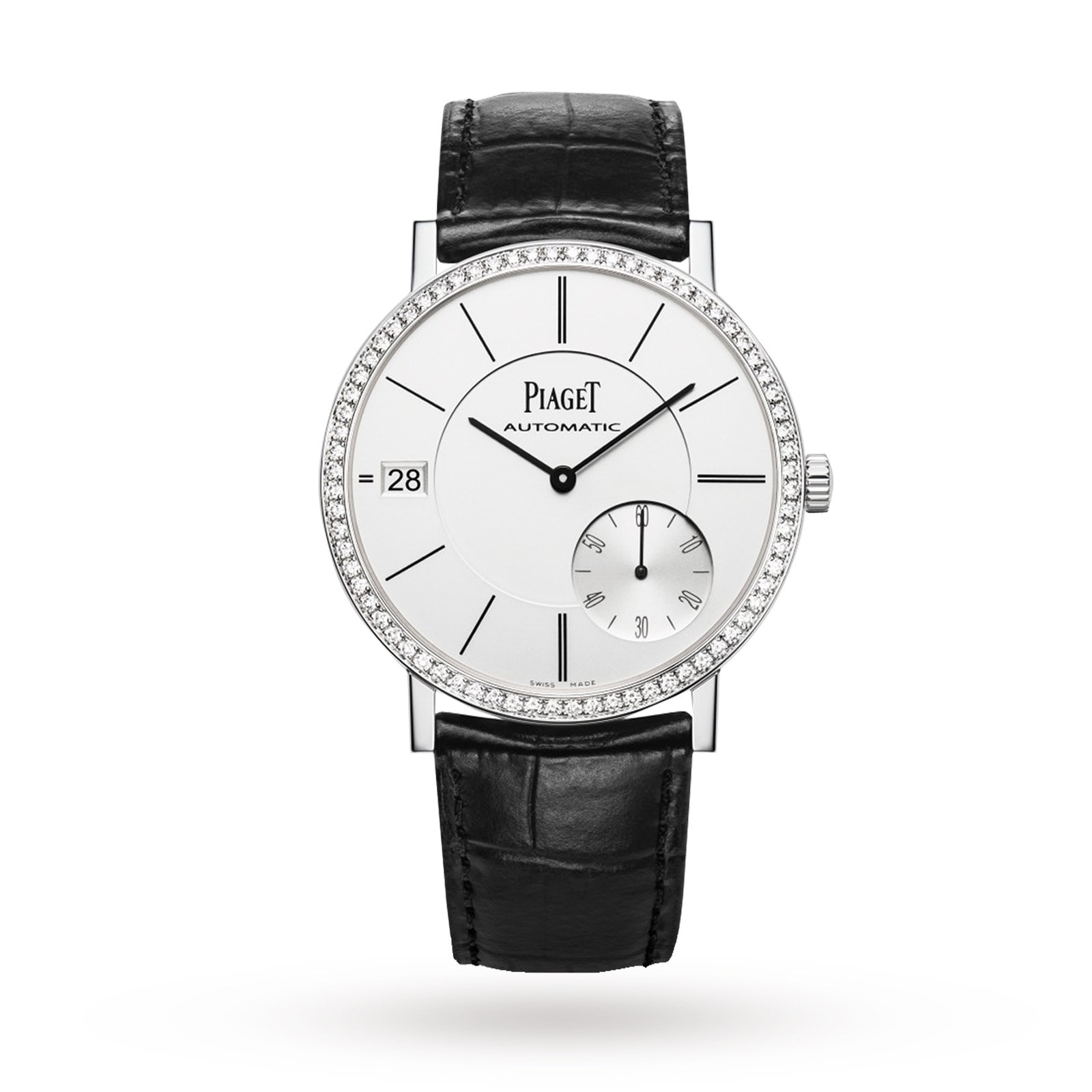
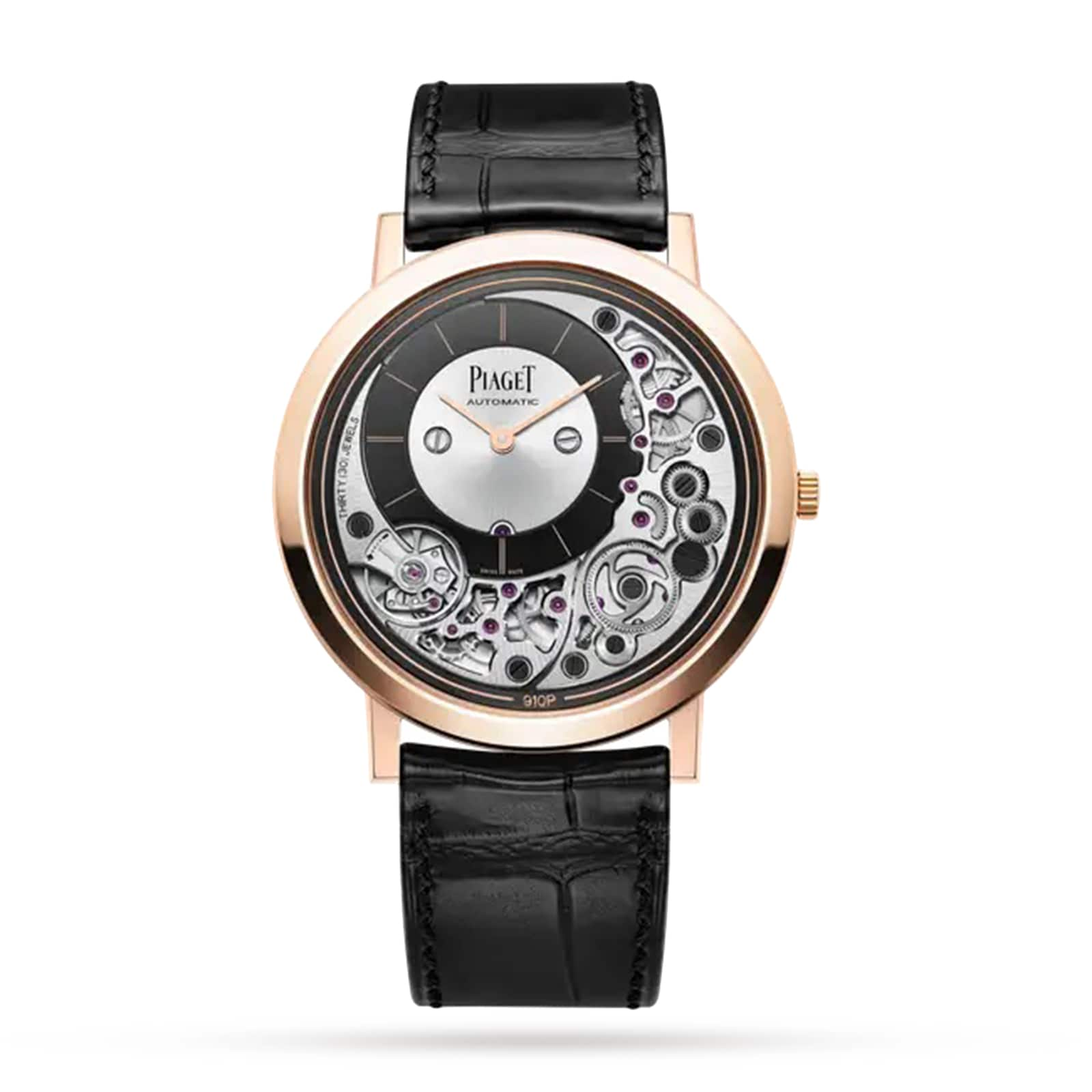
Price range £5,150 to £44,100 across 28 Piaget watches in stock.The Altiplano Ultimate Automatic exists to answer a single engineering question: how thin can a self-winding watch be made without sacrificing structural integrity? Piaget's answer was to abandon the conventional separation between case and movement entirely. The rose gold caseback becomes the baseplate to which the 219 components of calibre 910P are fixed, fusing mechanism and case into one object. The inverted layout that follows from this — bridges and gear train visible on the dial side, a peripheral 22-carat gold rotor with black PVD riding the outermost edge to keep height in check — is not an aesthetic choice but a consequence of the engineering, and it results in a watch just 4.30mm thick. At 41mm the case is not small, but lug-to-lug it spans only 45.2mm, so it lies entirely within the wrist rather than bridging it. On the wrist this reads as an almost implausible flatness — no ridge under a cuff, no profile to speak of. The dial is organised around an off-centre subdial at ten o'clock carrying the hours and minutes against a black chapter ring, leaving the sunray silver centre as open, reflective space. That openness is partly practical: it is where the suspended barrel sits, held by a single bridge on the dial side, and there is simply nothing else to put there.
- Reference
- G0A43120
- Brand
- Piaget
- Collection
- Altiplano
- Case size
- 41mm
- Case thickness
- 4.30mm
- Case material
- Rose gold
- Case shape
- Round
- Dial
- Silver
- Crystal
- Sapphire
- Movement
- Automatic
- Calibre
- 910P
- Water resistance
- 20m
- Bracelet / strap
- Leather strap
- Strap colour
- Black
- Clasp
- Buckle
- Lume
- Luminous
- Retailer
- Mappin & Webb
Additional specifications
- Lug-to-lug
- 45.2mm
- Power reserve
- 50 hours
Learn more about Piaget
Georges Piaget set up a workshop on the family farm in La Côte-aux-Fées in 1874, producing movements for other houses. The name did not appear on dials until 1943, and the decision that defined the company came a decade later.
In 1957 Piaget released the calibre 9P, a hand-wound movement two millimetres thick. The 12P automatic followed in 1960 at 2.3mm, then the thinnest automatic in the world. Thinness became the house obsession and its competitive territory, pursued through decades of records and continuing in the Altiplano line — including complete watches, case and all, under four millimetres.
Extreme thinness forced Piaget into a distinctive aesthetic. There was no room for conventional dials, so the company used hardstone: lapis, opal, turquoise, tiger's eye. The 1960s and 70s cuff watches, with woven gold bracelets and gem-set bezels, made Piaget as much a jeweller as a watchmaker, and the Polo of 1979 gave it an integrated gold sports watch of its own.
The company remained family-run until 1988, when it was acquired by Cartier — later folded into Richemont — and it continues to manufacture ultra-thin calibres at La Côte-aux-Fées while assembling and gem-setting in Geneva.
- 1874
- Georges Piaget founds the workshop at La Côte-aux-Fées.
- 1943
- The Piaget name is registered as a brand.
- 1957
- The 9P sets an ultra-thin benchmark at 2mm.
- 1960
- The 12P becomes the thinnest automatic movement.
- 1979
- The Polo launches.
- 1988
- Acquired by Cartier, later Richemont.
Also in 6 collections
This watch appears in the Piaget Altiplano range (7), Back in Stock (4,191), Automatic Watches (1,701), Leather Strap Watches (929), Silver Dial Watches (637) and Solid Gold Watches (164).
What the specifications mean
A slim watch on leather, made for wearing with a shirt.
Strengths
- 4.3mm is unusually slim for a 41mm case
- 45.2mm lug-to-lug keeps the 41mm case wearable
- Sapphire crystal, which resists scratching
- Luminous hands and markers for low light
- One of Piaget's more premium watches
Worth knowing
- 20m means keeping it away from water
Piaget Altiplano alternatives
Watches from other brands at a similar price, style and size, so you can see what else your budget can buy.
| Specification | G0A43120 | 914209380 | 1-36-12-02-05-62 |
|---|---|---|---|
| Price | £34,700 | £33,600 | £34,700 |
| Case size | 41mm | 42mm | 42mm |
| Water resistance | 20m | 30m | 50m |
| Movement | Automatic | Automatic | Automatic |
| Strap | Leather strap | Rubber strap | Leather strap |
| Power reserve | 50 hours | 52 hours | — |
| This watch |
|
|
Your new watch
Frequently asked questions, and things you should know about this watch
Can I swim with it?
No. At 20m it will survive rain and handwashing, but not submersion of any kind.
Water resistance explainedWill the glass scratch?
Unlikely. Sapphire is second only to diamond in hardness and shrugs off everyday marking.
Sapphire, mineral and acrylic comparedDoes it need a battery?
No. It is automatic — the motion of your wrist winds it, and there is no cell to replace.
Quartz, automatic and solar comparedHow long does it run for when it's not worn?
About 50 hours fully wound — enough to survive a night off the wrist, but not a full weekend.
Will it fit my wrist?
Lug-to-lug is 45.2mm, which suits wrists from roughly 16cm (6¼ inches) upward.
Lug-to-lug decides fit more than case diameter does.
How to size a watch to your wristIs it a men's or women's watch?
Listed as men's.
Cheapest place to buy
Mappin & Webb is the only UK retailer we track stocking this reference, so there is nothing to compare it against today.
More Piaget watches like the Altiplano
In stock, and close on style and price